
Hendry County Court Records After a Jail Arrest
When someone is arrested and booked in Hendry County, the jail creates a custody record. The court record is a separate thing that opens later. The Office of the State Attorney for the Twentieth Judicial Circuit reviews the arrest reports, decides whether the evidence supports charges, and files them with the court. That filing is what turns an arrest into a case with a number, a docket, and a public court record.
So two records exist side by side after an arrest. For the booking and custody side, the jail inmate records page covers the roster, and the jail mugshots page covers booking photos. The court record, by contrast, tracks the charges the prosecutor filed and how the case moves through the courts. Knowing that the booking charge and the filed charge can differ is the heart of reading court records after an arrest.
The charging office for Hendry County is the State Attorney for the Twentieth Judicial Circuit, whose official site is shown below at sao20.org.
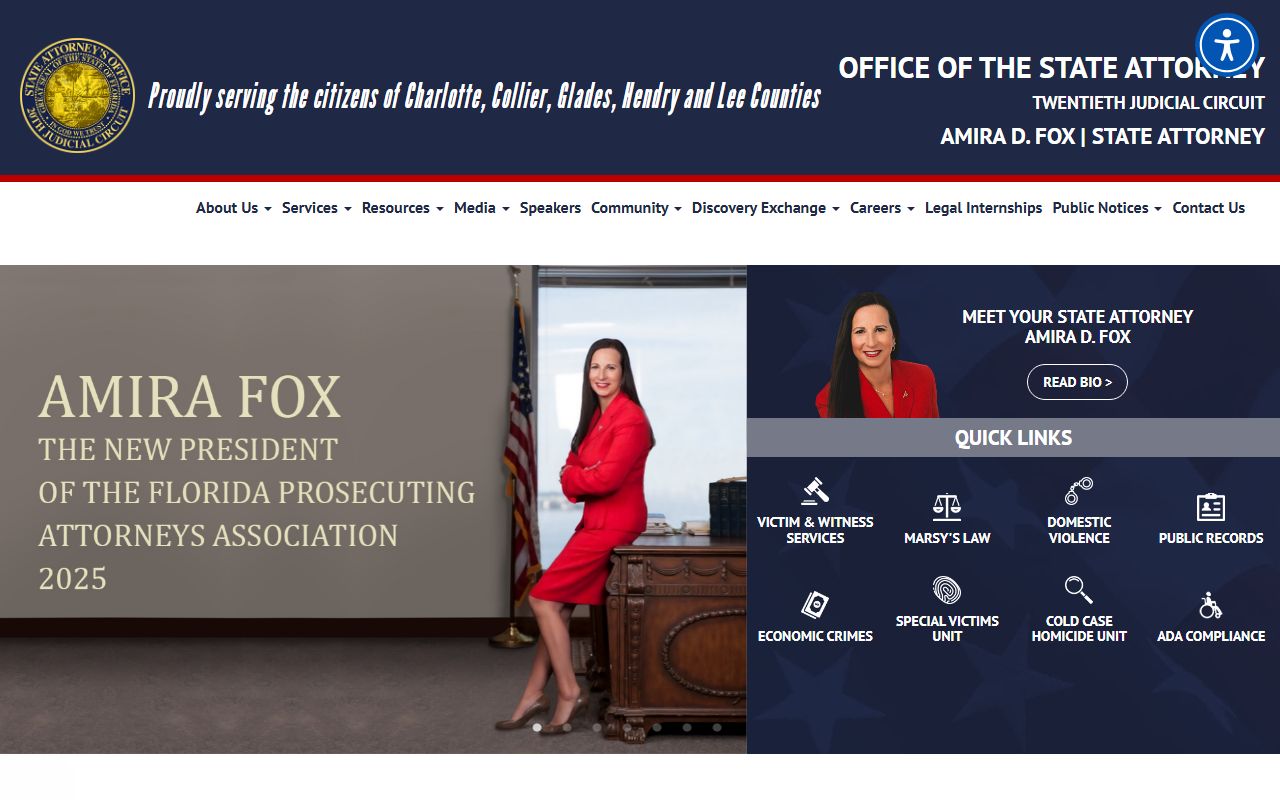
Led by State Attorney Amira D. Fox, that office reviews each arrest for legal sufficiency and decides which charges become the court record.
How to Find Hendry County Court Records After an Arrest
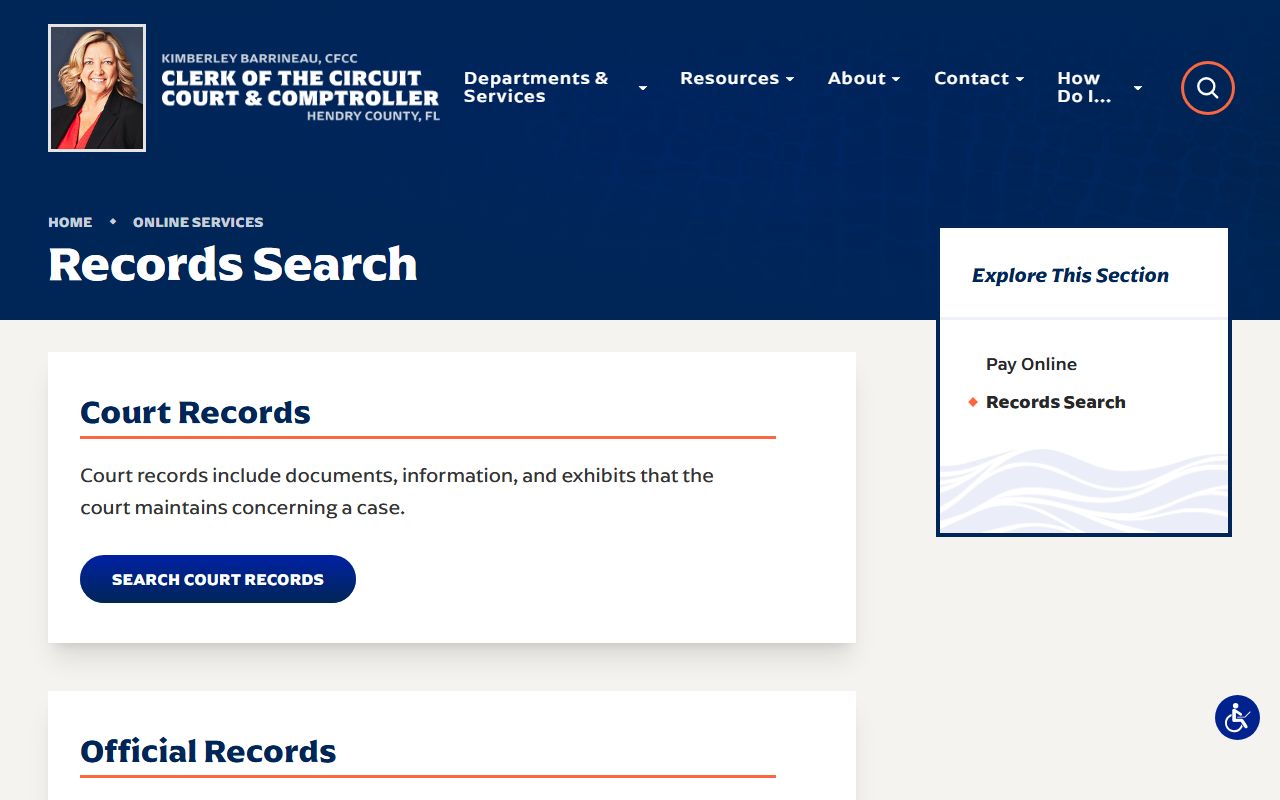
Court cases are kept by the Clerk of Court, not the sheriff. The Hendry County Clerk records search is the official route to look up a case, read the charges, and follow the docket. Booking and arrest detail still lives on the jail roster, but charge status and hearings live in the clerk's court index.
- Open the Hendry County Clerk records search page.
- Search by the defendant's name, or by case number if you have one from a citation, warrant, or court notice.
- Open the case and read the list of filed charges.
- Check each charge's level and current status, and note any hearing dates and bond entries.
The clerk's search page is the front door for these records, shown below.
For a statewide criminal-history check rather than a single case, Florida's criminal justice information system under state law is the broader tool, separate from this local court index.
How Charges Get Filed After an Arrest: Complaint, Information, and Indictment
The case begins with a charging document. After booking, the prosecutor decides how to charge, and the type of document depends on the offense. A misdemeanor often moves on a complaint, many felonies move by information, and the most serious felonies can go to a grand jury for an indictment. Each one starts a court record that the clerk then tracks.
| Complaint | Information | Indictment | |
|---|---|---|---|
| Filed By | Officer / Prosecutor | Prosecutor | Grand Jury |
| Common For | Misdemeanors | Many felonies | Serious felonies |
| Starts | The case | The case | The case |
Florida's procedure for charging by information or indictment is set in Chapter 907 of the Florida Statutes.
The State Attorney's Role in Court Records
The charges in a court record come from the prosecutor, not the arresting officer. Hendry County sits in the Twentieth Judicial Circuit, which also covers Charlotte, Collier, Glades, and Lee counties. The State Attorney for that circuit, Amira D. Fox, leads the office that reviews each arrest and decides what to file.
That review is why a booking charge and a court charge can differ. After an arrest, the office reads the reports, weighs the evidence for legal sufficiency, and then files, reduces, or declines charges. The result is the formal court record, which the clerk tracks through hearings to a final outcome. Reading the court file, rather than the arrest paperwork, is the only way to see which charges the state actually pursued.
Charge Status and What It Means After an Arrest
Charges are not fixed once an arrest is made. As a case moves, the prosecutor can amend, reduce, add, or drop a charge, and a judge can dismiss one. The booking charge on the jail roster is just a starting point, and the court record shows what actually held up. The terms below come up on almost every docket.
| Status | What It Means |
|---|---|
| Pending | The charge is open and not yet resolved. |
| Amended / Reduced | The prosecutor changed the charge or lowered it to a lesser offense. |
| Dismissed | The court or prosecutor ended the charge without a conviction. |
| Nolle Prosequi | The prosecutor chose not to go forward with the charge. |
Bond and Release After an Arrest
Bond is usually set at the first appearance, soon after booking, under Florida's bail rules. A judge can set a cash or surety bond, release a person on their own recognizance, or order no bond at all when the law or the situation calls for it. A hold from another agency can also keep someone in custody even after a local bond is posted.
| Bond Type | How It Works |
|---|---|
| Cash Bond | The full amount is deposited with the court as ordered. |
| Surety Bond | A licensed bail agent posts the bond for the defendant. |
| PR / Own Recognizance | The court releases the person on a promise to appear, without upfront cash. |
| No-Bond Hold | The person cannot be released until a court or holding agency clears the hold. |
The framework for these options is set in Chapter 903 of the Florida Statutes. The sheriff pages reviewed do not post a bond-payment page, so confirm accepted methods with the office before traveling to post a bond.
Warrants That Lead to an Arrest
Many arrests start with a warrant. A court issues an arrest warrant on a criminal allegation, or a bench warrant for a missed hearing or a violated order. When the person is taken into custody, the jail may book them and a roster card can appear. No public countywide warrant list was found on the sheriff's site during this review, so checking for a warrant runs through the court docket and the records channels instead.
To check, look at the clerk's court records for a case or bench warrant, call the sheriff at (863) 674-5600 for public-safety routing, or send a records request to records@hendrysheriff.org for what can be released. A warrant does not always mean the person is in the Hendry County Jail, since they could be elsewhere or not yet arrested.
Charges vs. Convictions in Court Records
An arrest and a charge are accusations, not proof of guilt. A conviction is a finding of guilt by plea or verdict. Court records after an arrest show both stages, and reading them carefully keeps a pending charge from being mistaken for a settled outcome.
| Charge | Conviction | |
|---|---|---|
| Stage | Accusation | Verdict or plea |
| Burden of Proof | Probable cause | Beyond reasonable doubt |
| Public Record | Yes | Yes |
Sealed vs. Expunged Arrest Records
Florida law lets eligible people seal or expunge a record through a court process. Sealing limits public access while the record still exists. Expunction removes or destroys the eligible record from public access. Neither is the same as asking a private website to take down a copied image, and both run through the courts under state law.
| Sealed | Expunged | |
|---|---|---|
| Visibility | Hidden from public view | Destroyed or treated as never existed |
| Law Enforcement | Limited access remains | Very limited access |
| Eligibility | Set by Florida court process and the disposition | Often after a dismissal or eligible outcome |
Background Check Considerations
A casual court-record lookup is not the same as a regulated background check. Formal screening for jobs, housing, or credit falls under the federal Fair Credit Reporting Act and must run through a compliant agency. A public court search is fine for personal knowledge, but it is not a substitute for that process.
Important: This site is not a consumer reporting agency under the FCRA, and its information may not be used for hiring, housing, credit, or insurance decisions.
Statewide Criminal History and the Court File
A single court case and a full criminal history are different records. The Hendry Clerk's index shows one county's cases. A statewide history draws on Florida's criminal justice information system, handled at the state level under Chapter 943, and it can include arrests and dispositions from across the state. For a fuller picture of a person's record, the statewide check reaches further than one county docket after an arrest.
Note: a statewide criminal-history search may carry a fee, so confirm the current cost with the state before relying on it.
Restricted Court Records After an Arrest in Hendry County
Not every court record after an arrest is open. Juvenile cases carry strong limits. Sealed and expunged charges are pulled from public view. Records tied to an active investigation can be withheld under the criminal-investigative exemptions in Florida's public-records law. The general rule under Chapter 119 is open access, but section 119.071 and related exemptions explain why some files stay closed.